By Chris Bondy
The Pioneer PDC product line is one that saw significant development and broader usage across 2025. The durability of the bits has increased, and with our latest designs, we are able to get up to 8 runs out of a single body. The cutting mechanics have improved and are now producing smaller cuttings while maintaining a superior typical dull condition. Blade failures on early designs occurred on very challenging wells and were pushed beyond recommended maximum operational parameters. Redesigns have made the bits more robust, and blade failures have been absent from the performance history of our latest revisions.
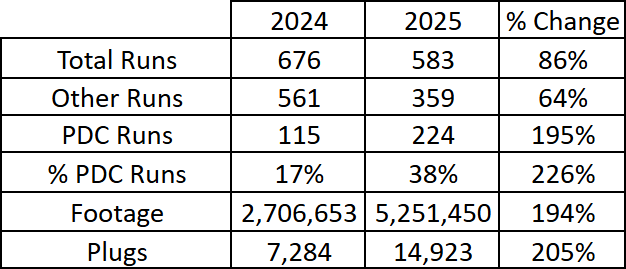
Over the lifespan of the Pioneer PDC product line, many customers have pivoted to rely on the exceptional performance capabilities of the Pioneer PDC. In 2025, 93% of our customers have increased their % Pioneer PDC usage across their drillout operations. Overall, Pioneer PDC usage has more than doubled from 17% across all operations to 38% in 2025. When compared to 2024, 2025 has shown that plugs drilled with Pioneer PDC has more than doubled (14,923 from 7,284), and drilled footage has almost doubled (5,251450’ from 2,706,653’). The widespread adoption of the Pioneer PDC has provided performance data indicating that it is an excellent option across all basins, as well as for Stickpipe, Coiled Tubing, and Hybrid drillout operations.
Pioneer PDC vs. Competitor Rollercone
Our top customer in the Northeast has transitioned completely to the Pioneer PDC line from a competitor’s rollercone bit in 2025. During Q1 and Q2, the competitor rollercone bit was almost exclusively used, and across Q3 and Q4, the Pioneer PDC was almost exclusively the bit of choice. This shift has resulted in drill times per plug being 14.5% faster, wash times per plug 18.1% faster, and combined drill and wash times per plug 17.5% faster. These improvements are over a sample size of nearly 50 wells for each bit type and all with stickpipe conveyance.
Parallel to this performance increase is an inherent reliability enhancement. PDC bits have no moving parts in contrast with rollercone bits, which have rotating cones. PDC bits use shear to cut through the plug, while rollercone bits use the impact of the teeth on the plug to break it apart. The shear puts more torsional (twisting) stress on the power section and workstring, both of which are designed to handle aggressive torque. The impact of the rollercone bits add axial vibrations and forces to the BHA and workstrings, which can raise the failure rate for other BHA components. The higher axial vibrations that are inherent to rollercone bits are reinforced by the readings from the InterrogatR tool, which can accurately record the downhole vibrations alongside the temp and pressure.
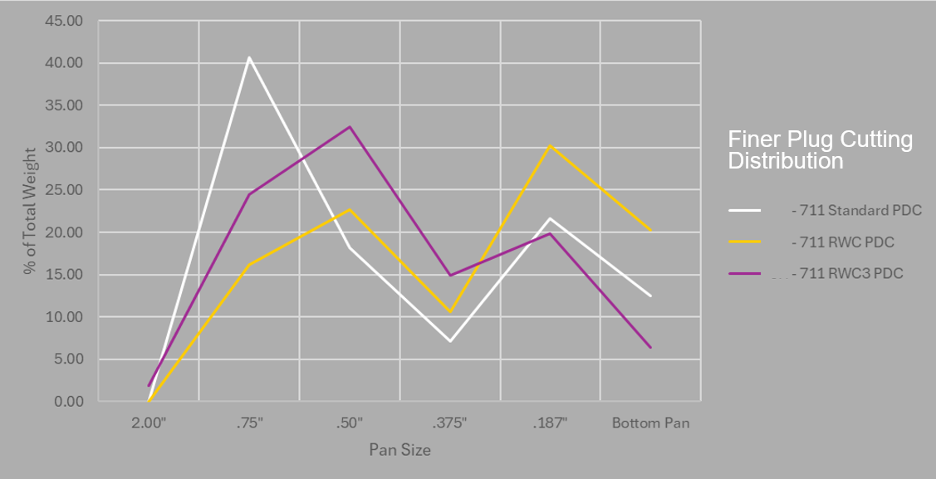
In regard to plug cutting sizing the chart below shows that the size distribution achieved is equivalent to, and in several size ranges better than, what is typically expected from a roller cone bit when compared to a PDC bit. The majority of the plug material is consistently broken down into smaller fragments, with no significant concentration of large cuttings. Notably, the distribution remains predominantly below 2 inches, which reduces the risk of large plug components returning to surface during drillout operations with a PDC bit. This finer, more controlled fragmentation improves hole cleanliness, minimizes the potential for handling issues, and supports safer, more efficient PDC drillout performance.
Figures